
Beginning to End - A Summary :
Weeping Camel starts out with the legend about a deer who borrowed a camels horns and never returned it back. The family camel herders had a mother camel who's giving birth to a baby calf. The birth of this calf went well, but then the mother camel rejects her young calf. The days after the birth of baby calf, the herders tries to get the calf to get its milk from the mother camel but she still rejects the calf, kicking and pushing the calf away from her breast. It was as if the mother camel will attack the calf if it was near her, thus the herders kept the two camels apart at a distance. And so to milk the calf the herders uses a horn- like instrument that is used as a cup, and filled it up with the mother calf's milk and fed her young one. The family camel herders were not sure of what was the problem and thus called upon for a sacrificial ritual to help bring the two mother camel and calf together as one. But that ritual did not work as the outcome was still the same, therefore the grandparents in the family orders their grandson along with another village son to go to town to go and buy batteries and to also ask help from a Morin Khurr violinist. When the Morin Khurr violinist came to their home, he proceeds with the ritual, having both the mother and baby calf camel be near to one another. The Morin Khurr violinist plays the Morin Khurr instrument and along with the tune the wife of the third generation family herders sings a song to the mother camel. After the song was done the mother camel finally allows the calf to get its milk from her.
The Family Camel Herders:
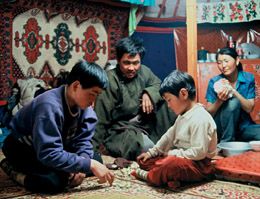
In a typical Mongolian herder family, there are about four generation living under the same roof. In Weeping Camel there are supposly four, but the great grandparents, Jamchur and Chemed, live in their own home next to their child and grandchildren. Thus leaving Anga and Zevel, the grandparents, Dgoo and Ikhee the child and wife, and their children, Ugna and Guntee, to live in one home.

The familly structure is that each married couple live in their own tent and the sons usually gets a share of the herd. The youngest or one of the son will get to inherit the family tent and herds and the other sons forming their own familly around with their own share of the herd. Each married sons work closely with one another in the same herding camp, but those who wishes to leave the same herding camp can do so too.

The familly structure is that each married couple live in their own tent and the sons usually gets a share of the herd. The youngest or one of the son will get to inherit the family tent and herds and the other sons forming their own familly around with their own share of the herd. Each married sons work closely with one another in the same herding camp, but those who wishes to leave the same herding camp can do so too.

Camel:
These camels are known as the wild two- humped Bactrian camels. The camels in Mongolia are precious to the land since these camels are what the herding economy depends on and have been domesticated for more than three thousand years. Since camels can carry at least 200 kilograms and work in the harsh winter of the Gobi Desert more than a horse can; thus being the favored domestic animal. Camels also can last longer in such climate weather in the dry Gobi Desert that they can last 9 days without water and 33 days without food. But then again the problem that every herders face with is the access to water. Since most wells are not machined drawn from the earth, it is hand drawn instead, which is a lot of works and these camels do not drink very little; they drink approximately 100-120 liters of water compared to horse, that drinks about 40 to 50 liters.

Not only does these camels help with labor but also their wools are precious to the Mongolian people too. They give about 5 to 8 kilograms of wools per year. Along with that the camels also produce milk, producing about 600 liters a year too, that helps the people produce cheese, butter and drinks.
Morin Khuur:
The Morin Khuur, or the Mongolian Horse Fiddle, is an instrument that has always been in the Mongolian tradition and culture. In the Mongolian language, Morin means horse. Back then horses were the peoples treasure as their transportation support and as a friend.

There were many legend about the creation of this instrument. This instrument is so important that it is place as first in the nation's musical instruments. Many of the Mongolian songs, dances, stories, and rituals uses the Morin Khuur instrument too. The Morin Khuur has also been said to help bring a mother ewe and her baby calf together when the mother ewe rejects the calf of milking, hearing the tune from the Morin Khuur will the mother ewe accepts the calf. And this is seen in the Weeping Camel too, when the mother camel rejects her calf of care and duty and after the Morin Khuur was played to her (the mother camel), she allows her calf to drink milk and be by her again.
Developing Society:
In Weeping Camel, the little son Ugna goes into town with a neighbor boy, Dude. Where the family herders live is more rural, so as Ugna enters the town, he's fascinated by all the modern things, especially the t.v. We can see that there is a really big difference between where Ugna and his family lives to the more developed town that Ugna and Dude enters.
 Since almost everyone there were not wearing traditional clothings but were instead in jeans and jackets. The towns people owns stores, and sells imported materials and needs and there are electricity poles and schools.

Not only does these camels help with labor but also their wools are precious to the Mongolian people too. They give about 5 to 8 kilograms of wools per year. Along with that the camels also produce milk, producing about 600 liters a year too, that helps the people produce cheese, butter and drinks.
Morin Khuur:
The Morin Khuur, or the Mongolian Horse Fiddle, is an instrument that has always been in the Mongolian tradition and culture. In the Mongolian language, Morin means horse. Back then horses were the peoples treasure as their transportation support and as a friend.

There were many legend about the creation of this instrument. This instrument is so important that it is place as first in the nation's musical instruments. Many of the Mongolian songs, dances, stories, and rituals uses the Morin Khuur instrument too. The Morin Khuur has also been said to help bring a mother ewe and her baby calf together when the mother ewe rejects the calf of milking, hearing the tune from the Morin Khuur will the mother ewe accepts the calf. And this is seen in the Weeping Camel too, when the mother camel rejects her calf of care and duty and after the Morin Khuur was played to her (the mother camel), she allows her calf to drink milk and be by her again.
Developing Society:
In Weeping Camel, the little son Ugna goes into town with a neighbor boy, Dude. Where the family herders live is more rural, so as Ugna enters the town, he's fascinated by all the modern things, especially the t.v. We can see that there is a really big difference between where Ugna and his family lives to the more developed town that Ugna and Dude enters.
 Since almost everyone there were not wearing traditional clothings but were instead in jeans and jackets. The towns people owns stores, and sells imported materials and needs and there are electricity poles and schools.
No comments:
Post a Comment